

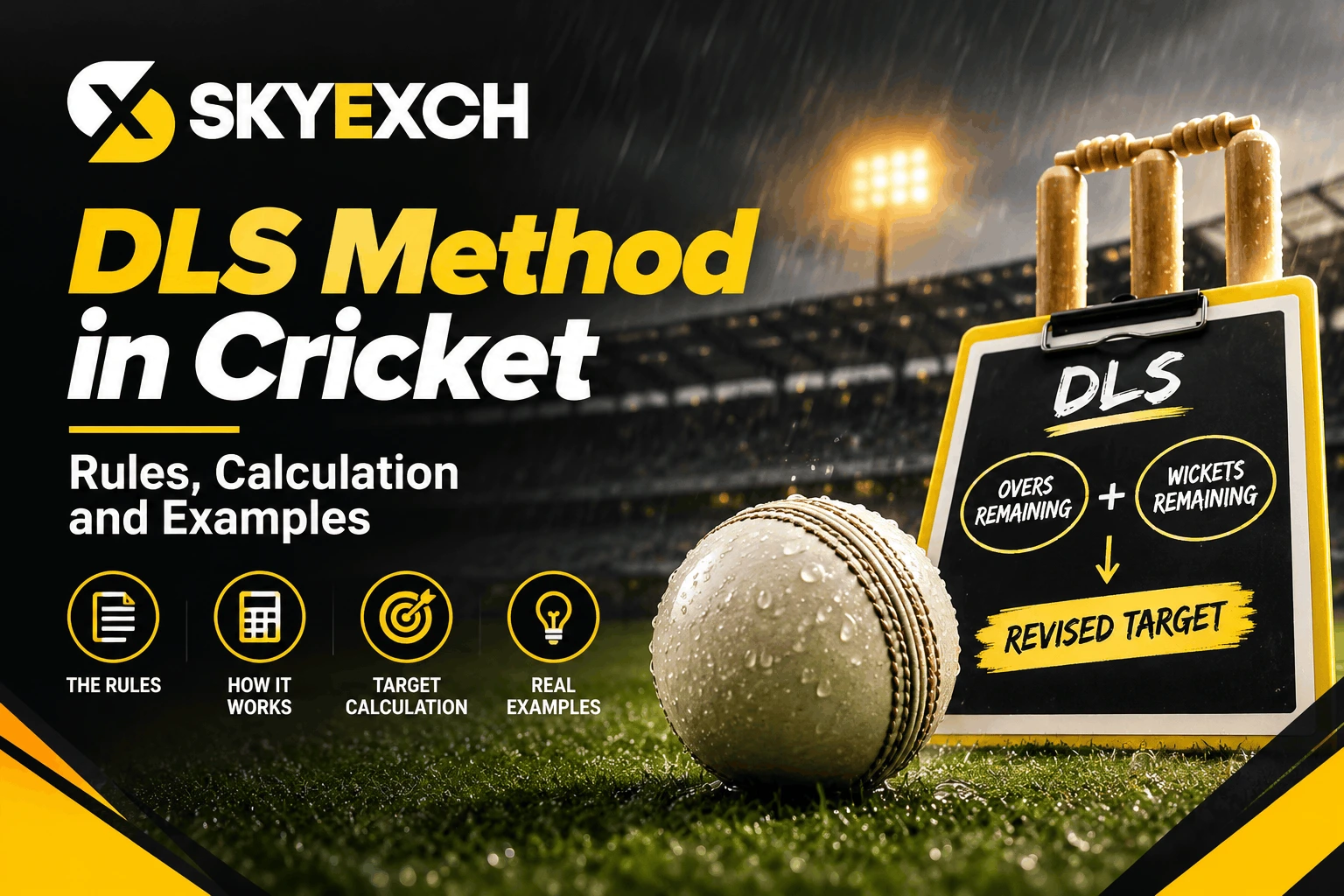
Imagine a team needs 280 runs to win a One Day International. It has scored 150 runs in 30 overs when heavy rain interrupts the match. After the delay, the remaining overs are reduced. The original target may no longer be appropriate, so officials use a mathematical method to determine a revised target. This is where the DLS method in cricket becomes important.
The Duckworth-Lewis-Stern (DLS) method is used in limited-overs cricket to adjust targets when rain or other interruptions reduce the available playing time. It aims to give both teams a fair contest based on the resources available to them. The International Cricket Council (ICC) formally adopted this method for interrupted matches.
What Is the DLS Method in Cricket?
The DLS method stands for Duckworth-Lewis-Stern. It calculates revised targets when a match loses playing time because of interruptions such as rain.
Rather than considering only the number of runs scored, the method considers two important resources:
- Overs remaining: The number of deliveries the batting team still has available.
- Wickets remaining: The number of wickets the batting team has left before being bowled out.
These factors help estimate a team’s remaining scoring potential. A team with many overs and wickets available generally has more opportunities to score than a team with only a few wickets and overs left.
How Does the DLS Method Work?
The method uses statistical calculations and resource tables to determine revised targets. Its main steps are:
- Officials assess how much playing time has been lost.
- The available overs for the innings are determined.
- The resources available to each team are calculated using overs and wickets.
- The DLS calculation establishes a revised target for the chasing team.
- If further interruptions occur, the target may be recalculated according to the applicable playing conditions.
The exact calculation is more complex than a simple run-rate comparison. It accounts for the relationship between overs, wickets and scoring opportunities.
Explore More: Skyexch333-Sky Exchange Cricket App – Features and Cricket Betting Options
DLS Method Example in Cricket
Suppose Team A scores 270 runs in a 50-over match. Team B begins its chase but rain interrupts play, leaving fewer overs available than originally scheduled.
Team B cannot always be expected to chase the original target under the reduced conditions. Officials apply the DLS method to determine a revised target based on the circumstances and resources available.
For example, if the chasing team has already lost several wickets, its remaining scoring resources may be lower than those of a team with the same number of overs remaining but more wickets in hand.
This is why two interrupted matches with similar scores may receive different revised targets. The official calculation depends on the actual match situation.
Why Is the DLS Method Important?
The DLS method helps maintain competitive balance when weather interrupts a match. Without a revised target, the team batting second could face an unfair disadvantage or benefit from having fewer overs to chase a total.
It is particularly important in ODIs and T20 matches, where innings have a fixed number of overs. The method also helps officials establish par scores during interrupted chases, allowing the match result to be determined under the relevant playing conditions.
However, DLS does not guarantee a perfect prediction of how many runs a team would score. It is a statistical method designed to adjust targets fairly.
DLS Method vs Normal Run Rate
A normal run rate measures runs scored per over. The DLS method goes further by accounting for available batting resources.
For example, a team scoring quickly early in an innings may still have many wickets available. Another team might have scored the same number of runs but lost several wickets. Their remaining scoring potential may differ, which is why run rate alone cannot determine a fair revised target.
Frequently Asked Questions
-
What does DLS stand for in cricket?
DLS stands for Duckworth-Lewis-Stern, a method used to calculate revised targets in interrupted limited-overs matches.
-
When is the DLS method used?
It is used when interruptions, such as rain, reduce the available playing time in eligible limited-overs matches.
-
Does DLS apply to Test cricket?
The method is primarily used in limited-overs formats, such as ODIs and T20 matches, rather than conventional Test match results.
-
Does DLS depend only on runs scored?
No. It considers available overs and wickets, along with the statistical resource calculations used to establish a revised target.
Read More: Skyexch333-SkyExchange Cricket IPL – IPL Betting Markets and Features
Conclusion
The DLS method in cricket plays an important role when rain or other interruptions affect limited-overs matches. By considering overs remaining and wickets available, it helps officials calculate revised targets and determine results under the applicable playing conditions. Understanding this method makes rain-affected matches easier to follow and explains why a target can change during a game.
For more cricket rules and sports guides, explore the educational content available on Skyexch333. Always follow applicable local laws and approach gambling-related activities responsibly.